Why Your AC Works Harder in the Tri-Cities, Than (Almost) Anywhere Else
Summers in Pasco hit different, and your AC can tell, even if you can’t.
May 1, 2026 · 3 min read
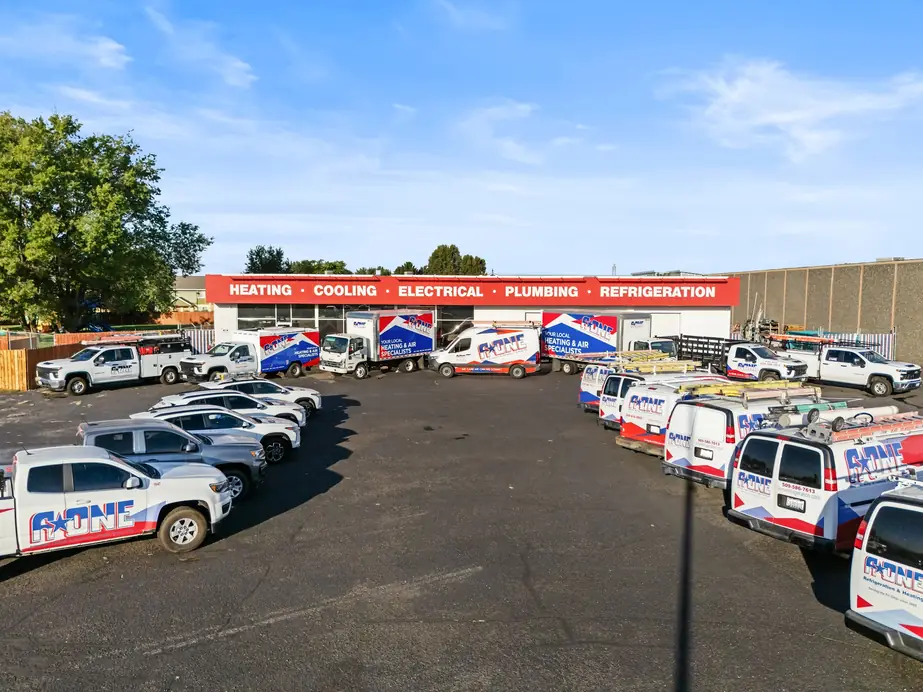
Summers in Pasco hit different, and your AC can tell, even if you can’t. The science behind it is actually kind of wild.
You’ve probably heard somebody say “well at least it’s a dry heat” (probably somebody’s dad) as the thermometer climbs past 100.
And technically, yes, the low humidity does make the air feel more tolerable than it would in, say, Houston.
But your air conditioner doesn’t care about how it feels. Your AC cares about a handful of very specific environmental factors, and the Tri-Cities stack them up in a pretty rough combination. If you’ve ever wondered why your system seems to run constantly on August afternoons, or why it wears out faster than the manufacturer’s lifespan suggests, here’s what’s actually going on.
The temperature swings are brutal on equipment
One of the most punishing things for an AC isn’t just heat. It’s the gap between daytime highs and nighttime lows. In the Mid-Columbia, it’s not unusual to go from a 100-degree afternoon to a 55-degree early morning. That’s a 45-degree swing in about twelve hours, every single day for weeks on end.
Your system’s components expand and contract with those swings, and over years, that thermal cycling fatigues the copper refrigerant lines, stresses the compressor seals, and loosens electrical connections.
Houses in milder coastal climates simply don’t see this kind of stress!!
Dry air isn’t a free pass
People assume low humidity is easy mode for an AC because the unit doesn’t have to work hard pulling moisture out of the air. Technically true. But the flip side is that Tri-Cities summers get so hot that the raw cooling demand (the BTUs of heat your system has to move out of the house) is massive.
The system may not be dehumidifying much, but it’s moving a huge amount of raw heat energy, and the compressor runs hot and long. Combined with those temperature swings, it’s a recipe for equipment fatigue.
Dust, dust, and more dust!!
Anyone who’s lived here through a windy afternoon knows the Columbia Basin is a dust machine. Fine silty soil from surrounding farmland and sagebrush country gets picked up and redeposited on every outdoor surface, including the fins of your condenser.
A layer of dust on those fins acts like a blanket, trapping heat right where your system is trying to dump it. Performance drops, efficiency tanks, and the compressor works way harder than it should. Regular cleaning is essential here in a way it just isn’t in other climates.
Wildfire smoke season has changed everything
The last several years have made wildfire smoke an expected part of late summer in eastern Washington. When AQI spikes, your indoor air quality depends entirely on your system and filtration.
Running your AC with a standard filter during heavy smoke days doesn’t just make your home feel stuffy, it actively clogs your filter faster, restricts airflow through the system, and can ice up the evaporator coil.
This is one area where an upgrade to a better filter, or adding dedicated air cleaning, pays for itself in system longevity alone.
What to actually do about it
If you’re going to live with Tri-Cities summers, the honest answer is that your AC needs more care than it would almost anywhere else in the country.
A pre-summer tune-up in May catches all of the stuff that quietly built up over winter: refrigerant levels, capacitor health, coil cleanliness, electrical tightness.
Skipping that is the single biggest reason systems fail during the first 100-degree stretch of the year. Our team handles AC maintenance designed around what this specific climate actually does to equipment, not a generic national checklist.
Changing your filter every month during summer (not every three, not every season) is another small habit that makes a huge difference given the dust and smoke we deal with.
And if your system is more than ten years old and has been through a decade of these summers, it’s worth getting an honest opinion on whether repair or replacement makes more sense long-term.
Don’t wait for the first heat wave
The calls we hate getting the most are the ones that come in mid-July when the temperature has been over 95 for five days straight.
Every HVAC company in the Tri-Cities is slammed, parts are harder to get, and you’re sweating through the weekend waiting for a technician. Getting ahead of it now is so much easier!!
Call A-One and we’ll get your system ready for whatever this summer decides to throw at us.
A-One Air, (509) 586-7613
Call (509) 586-7613More articles
Why Dust is Your #1 Enemy Here in the Tri-Cities
Pasco gets less rain each year than Tucson, Arizona. That is not a typo, and it explains a lot about your bookshelf.
Did You Know, Your Water Heater is Full of ROCKS?
Okay, not rocks exactly. But if your water heater is more than a couple years old, there is a layer of real mineral stone sitting at the bottom of that tank right now.