Your Air Conditioner Is Not an Air Purifier
Your AC is very good at cooling your air, but cleaning it is a different story, and your AC filter, while great, does not purify your home’s air.
July 30, 2026 · 4 min read
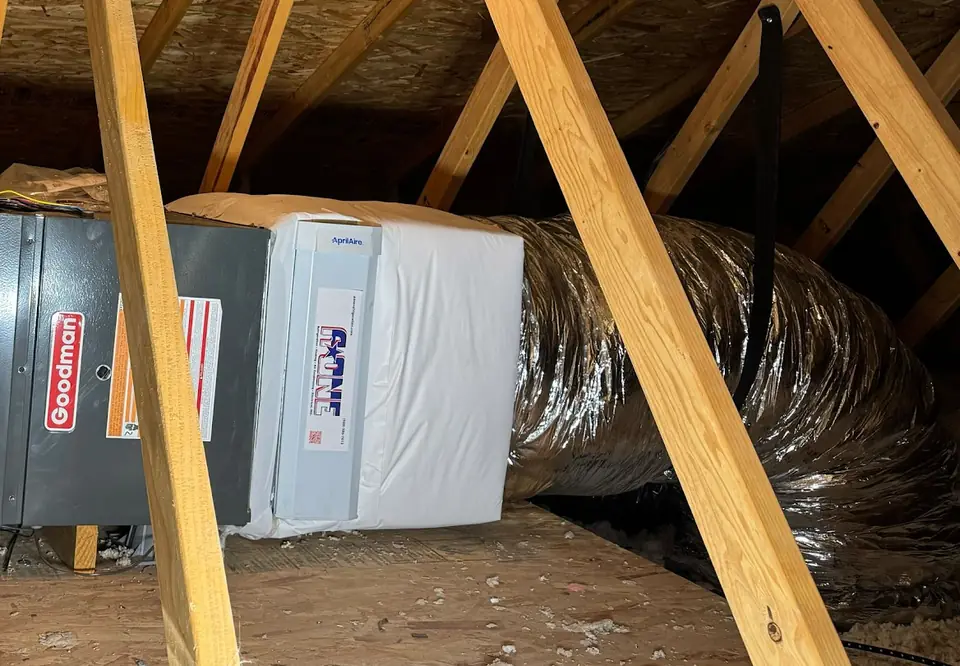
Your AC is very good at cooling your air, but cleaning it is a different story, and your AC filter, while great, does not purify your home’s air.
That tends to surprise people, and honestly the confusion makes sense. You close the windows, the system runs, the house feels better, and it’s a short mental hop from there to “the machine must be taking care of the air too.”
So let’s walk through what’s actually happening inside your system, because the job some people count on it for is something it was never meant to do!
Your filter has a job
The standard one-inch filter exists to keep dust, pet hair, and construction grit from caking onto your evaporator coil and slowly strangling the airflow. It’s there to protect expensive equipment, and it does that reasonably well.
The fact that it catches some airborne particles along the way is more of a side benefit than a feature. Basic filters grab the big visible stuff. The fine particles, the ones too small to see, mostly sail right through and come back out the vents.
So when somebody says “my AC filters the air,” they’re technically correct in a way that doesn’t help them much.
Smoke is the obvious example, but it’s not the only one
If you were here for smoke season last year (we wrote about that one already), you probably remember the drill. Windows shut, system running around the clock, and the house still smelled faintly of campfire.
That’s because smoke particles are ABSURDLY small, a fraction of a micron, and a standard filter has basically no opinion about them. The system circulated that smoky air very efficiently. Removing it was never on the menu.
But smoke gets all the attention because you can smell it, and that hides how much else rides around your ductwork the rest of the year without announcing itself. Cooking releases a fine grease aerosol every time you sear something. Pets shed dander constantly. Pollen comes in on the wind and on you. And then there’s the stuff coming off new carpet, fresh paint, and half the cleaning products under your sink, which no filter of any rating can catch, because those aren’t particles at all, they’re gasses.
None of that means your house is a hazard. It means “close the windows and run the AC” was never actually an air quality plan, even though most of us have been treating it like one for years.
Why the strongest filter on the shelf can backfire
The intuitive fix is to go buy the highest MERV number the hardware store carries. Please don’t do that without checking first.
Denser filter material restricts airflow, and your system was designed around a specific amount of resistance. Choke it down and the blower strains, the air slows, and in cooling season the coil can get cold enough to start icing over. Now the equipment is working harder, cooling worse, and wearing out faster, all because of a filter that was supposed to be an upgrade.
MERV 13 is roughly where filters start meaningfully capturing fine particles. Whether your particular system can actually handle a MERV 13 in a one-inch slot is a different question, and the answer honestly varies house to house depending on the equipment and the ductwork. Some systems take it in stride. Plenty don’t.
What works if clean air is actually the goal
The trick is to stop borrowing filtration from a machine that was built for something else and size the tool to the job.
A media cabinet holding a four or five inch filter is usually the first thing we’d suggest, since all that extra surface area means real particle capture without suffocating the airflow. A portable HEPA unit in whatever room you actually spend your evenings in is cheap and works immediately, and on a bad air day it’ll do more for you than anything happening in your ducts. And if you want a whole-home answer, there are options that go after the gasses too, which is territory no filter reaches.
The part where we defend your air conditioner
Your system isn’t failing you here. It’s doing exactly what it was engineered to do, which is move heat out of your house, and in a Tri-Cities August that is a full-time job all by itself.
Long run times right now are usually normal. Running nonstop while the house loses ground, or a new noise, or a bill that jumped for no reason you can name, those are different conversations, and a repair visit is how you find out which one you’re having.
But if what you really want is cleaner air, that’s a separate question with its own answer, and it starts with knowing what your equipment can support. Call A-One and we’ll tell you what your system can handle before you spend money on a filter that fights it.
A-One Air, (509) 586-7613
Call (509) 586-7613More articles
Why Dust is Your #1 Enemy Here in the Tri-Cities
Pasco gets less rain each year than Tucson, Arizona. That is not a typo, and it explains a lot about your bookshelf.
Did You Know, Your Water Heater is Full of ROCKS?
Okay, not rocks exactly. But if your water heater is more than a couple years old, there is a layer of real mineral stone sitting at the bottom of that tank right now.