Your Home’s Circuitry Could Ruin Your Hot Tub Party
Picture it: a perfect Saturday night in June. Everyone’s in the hot tub, drinks in hand, music going, finally that “summer is here for real” feeling. Then…the hot tub shuts off.
June 2, 2026 · 3 min read
Picture it: a perfect Saturday night in June. Everyone’s in the hot tub, drinks in hand, music going, finally that “summer is here for real” feeling. Then…the hot tub shuts off.
Or, specifically, the hot tub pump shuts off. Then, the lights flicker…Best case, you’ve got a frustrating end to a nice night. Worst case, you’ve got a serious electrical fire hazard hiding in the walls of your home.
So here’s why your pool pump, hot tub, and other big summer power draws absolutely need their own circuit, and why this is the #1 thing to check before opening up your pool this year.
What “their own circuit” actually means
Every outlet and fixture in your home is connected to a circuit, and each circuit can only safely handle a limited amount of electrical current. Most household circuits are 15 or 20 amps.
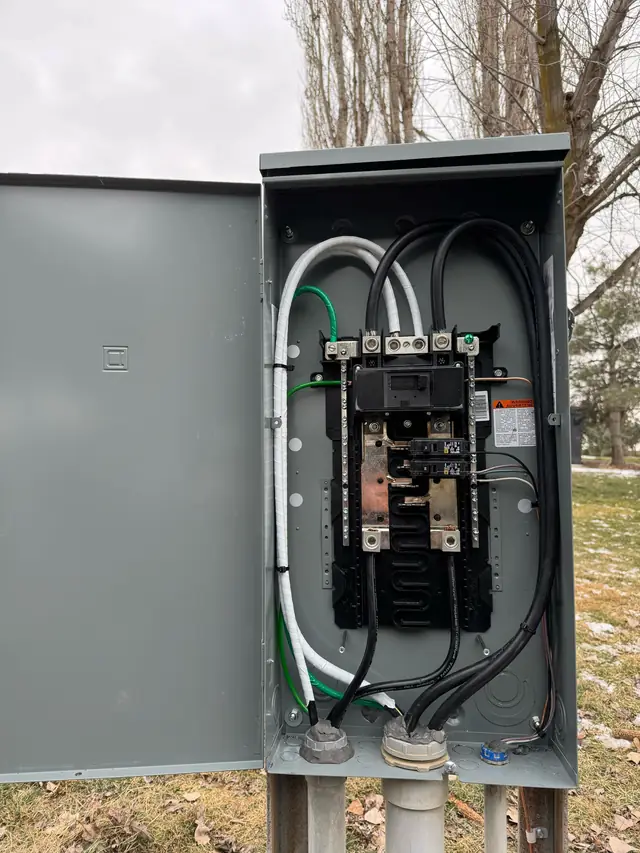
A pool pump, depending on horsepower, can draw a significant portion of that all by itself. A hot tub can pull even more, especially when the heater and the pump are both running. Add in a stereo, some patio lights, maybe a phone charging nearby, and you’ve packed a lot of demand onto one circuit. Putting heavy-duty equipment like that on a shared circuit is asking for trouble. A dedicated circuit means that equipment has its own line straight back to the panel, with its own breaker, sized correctly for the load.
The warning signs your circuit can’t handle it
You might already be seeing the signs without realizing what they mean.
- Breakers tripping when the hot tub kicks on, especially while other things are running
- Lights dimming or flickering when the pool pump cycles
- The outlet powering your equipment feeling warm to the touch
- A faint burning smell near the panel or near the outlet
- Buzzing or humming sounds from the panel itself
Any of these is your home telling you it’s working harder than it should be to power what you’re plugging in. And the consequences of ignoring it range from “annoying” to “actually dangerous.”
Why this matters more in the Tri-Cities
A few reasons it hits different here in Eastern Washington:
Our summer heat is intense, which means pool pumps run for long stretches every day and hot tub heaters work harder to maintain temperature when there’s a big day-to-night temperature swing.
A lot of homes in the area were built in eras when pools and hot tubs were less common, meaning the original electrical panel wasn’t designed with that kind of seasonal load in mind. Tacking new equipment onto existing circuits is a really common shortcut, and it’s one of the most common electrical problems we see.
The wildfire-and-dust conditions out here also accelerate wear on outdoor electrical components, so a circuit that was “fine” three years ago might not be fine now.
What a dedicated circuit setup actually involves
Don’t worry, it’s less dramatic than you’d think! A licensed electrician runs a new circuit from your main panel directly to where the equipment lives. The circuit is sized correctly for the equipment’s draw, with the right gauge wire, the right breaker, and proper GFCI protection (required by code for anything near water, for very good reasons).
For most pool pumps and hot tubs, it’s a one-day project. For homes that need a panel upgrade to make room for the new circuit, it might take a little longer, but you’ll end up with a safer, more capable electrical system overall.
Our team handles electrical installation work like this constantly in the Tri-Cities, especially in June when everyone’s getting their backyards ready for summer.
The cost of not doing it right
Cutting corners here is genuinely one of the worst gambles you can take with your home. An overloaded circuit running a hot tub doesn’t just trip the breaker. Over time, it heats up the wiring inside your walls, degrades the insulation around those wires, and creates real fire risk. Houses lost to electrical fires often started with someone plugging too much into a circuit that wasn’t sized for it.
The fix is usually a one-time cost. But, the damage from trying to do it yourself (or getting your buddy to) can be catastrophic.
Before the next pool day
If you’re opening up the pool, firing up the hot tub for the first time this season, or even just plugging in any new outdoor equipment, take five minutes and check what’s running on what. Better yet, have an A-One Air electrician come take a look!
Call A-One and we’ll make sure your summer setup is wired to actually handle the fun.
A-One Air, (509) 586-7613
Call (509) 586-7613More articles
Why Dust is Your #1 Enemy Here in the Tri-Cities
Pasco gets less rain each year than Tucson, Arizona. That is not a typo, and it explains a lot about your bookshelf.
Did You Know, Your Water Heater is Full of ROCKS?
Okay, not rocks exactly. But if your water heater is more than a couple years old, there is a layer of real mineral stone sitting at the bottom of that tank right now.