Heating · Cooling
AC repair in the Tri-Cities
When the air conditioner quits in a Tri-Cities heat wave, A-One measures the system, finds the part that actually failed and fixes that. Emergency service runs 24/7.
Chapter 01
The capacitor, the contactor and the coil are where an AC usually fails first
Most air conditioners that quit in a Tri-Cities heat wave fail at one of a few small parts. A run capacitor weakens and the compressor or fan motor cannot start. A contactor pits its contacts after thousands of cycles and stops passing power to the condenser. Either one leaves the unit humming or silent while the house warms up. Both are inexpensive parts on a machine that is otherwise sound, which is why finding them beats swapping the whole unit.
Other failures look different. A low refrigerant charge means a leak somewhere, and the evaporator coil freezes into a block of ice so almost no air moves. A dragging blower motor, a condensate drain that backs up and trips the float switch, and a condenser coil caked with dust after a windy week can all arrive as the same complaint: the house will not cool. When the outdoor air is over 100 degrees, each of these gets worse quickly.
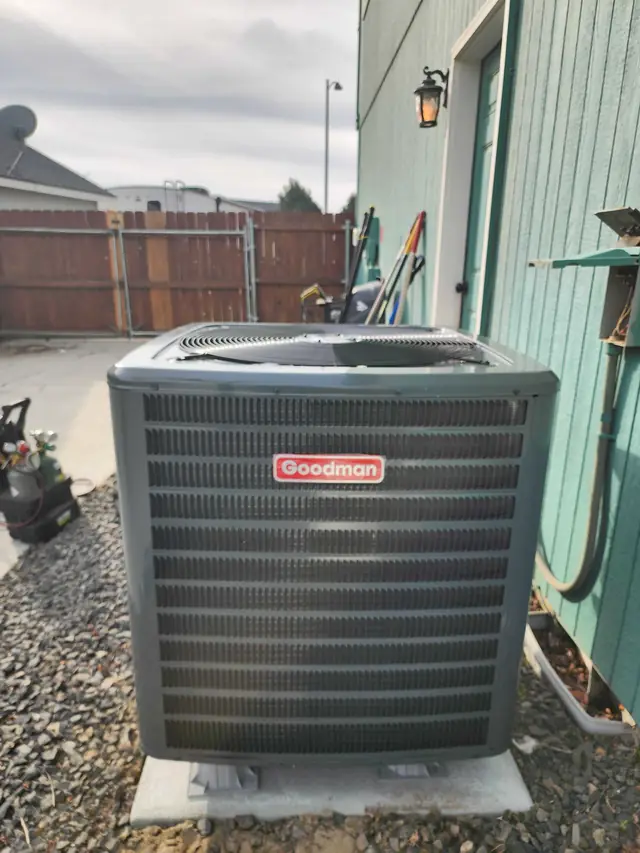
New A-One condenser set on a concrete pad beside a house
An A-One tech proves the fault with measurements before replacing a part
The visit starts with the simple checks: the thermostat call, the breaker, the outdoor disconnect and the air filter. Then the tech measures. Capacitor microfarads are read against the rating on its label, voltage is checked at the contactor, and amp draw is taken on the compressor and both motors. The temperature drop across the coil and the refrigerant pressures are compared with indoor and outdoor conditions, not a number from memory.
If the charge is low, the tech looks for the leak before adding refrigerant, because topping off a leaking system only buys a few weeks. A frozen coil is thawed and the airflow cause is found, whether that is a clogged filter, a failing blower or a blocked return. You hear what failed, what it does and what the repair involves before the work starts. A-One offers 24/7 emergency service for the nights that cannot wait.
Chapter 03
After an AC repair, watch how the system handles the next hot afternoons
A good repair holds through the next stretch of 100 degree days. Watch for the signs that brought you in: warm air at the vents, ice on the copper line at the outdoor unit, water around the indoor furnace or air handler, or a unit that shuts off and restarts every few minutes. Any of those after a repair means something else is still marginal, and it is worth a call to the shop.
Keep the outdoor unit clear. Dust and weed seed blown in from the open ground around Pasco and Kennewick clog the condenser fins, and a clogged coil runs hot and wears out the compressor sooner. Rinse it gently with a garden hose, never a pressure washer, with the power off at the disconnect. Change the filter on schedule. Service parts on A-One repairs carry a 2-Year Warranty, so say so if a repaired part acts up.
A-One has worked on Tri-Cities heating and cooling since 1980. 2-Year Warranty on all service parts, with an optional 10 Year warranty on parts and labor.
Heating & CoolingSince 1980
More from the A-One Heating & Cooling crew
A yearly AC tune-up from A-One covers the system from the outdoor coil to the condensate drain, before dust and 100 degree afternoons turn a weak part into a breakdown.
A-One sizes the system to the house, checks the ducts and installs Amana, Daikin or Goodman equipment. A-One is also a Lennox Premier Dealer.
A-One cleans supply and return ducts under negative pressure, so the dust that wind and harvest push into a Tri-Cities house leaves through the vacuum instead of the registers.